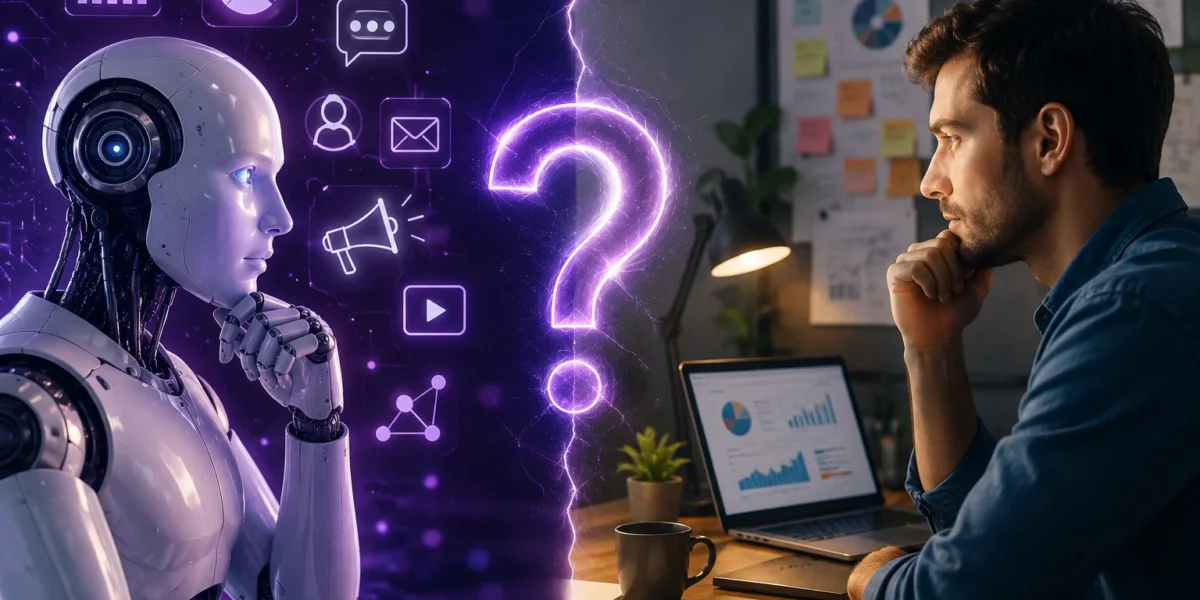

If you work in marketing, you have probably asked yourself this question at least once this year. Maybe a tool wrote an ad in seconds that would have taken you an hour. Maybe your team got smaller. The fear is real, and pretending it is not would be dishonest.
So here is the honest answer in 2026: AI will not replace digital marketers as a whole, but it is already replacing a specific kind of marketer. The person who only does repetitive, task-based work is in serious trouble. The person who thinks, decides, and directs is more valuable than ever.
This is not a comforting “AI is just a tool” article. The data tells a sharper, more uncomfortable story, and you deserve to see it clearly. By the end, you will know exactly which side of the line you are on and how to move to the safe side.
What the Numbers Actually Say in 2026
Adoption is no longer a question. As of early 2026, 91% of marketing professionals report using AI in their daily work, up sharply from 63% a year earlier. Some surveys put daily usage as high as 97%. AI is not coming. It is already sitting at every desk in the building.
But there is a twist that most scary headlines miss. While almost everyone uses AI, only about 6% of marketing teams have fully built it into their complete, end-to-end workflows. Most teams use it for the easy wins: writing first drafts, brainstorming ideas, and creating quick social posts. Around 87% use it for content creation and copywriting.
This gap between “everyone uses it” and “almost nobody uses it deeply” is the single most important fact for your career. It means the panic is running ahead of the reality. The marketers who learn to use AI for high-value work, not just quick drafts, are stepping into a wide-open field. We covered this shift in detail in our guide on how AI is transforming digital marketing in 2026.
The Honest Part: Which Marketing Jobs AI Is Replacing
Let us not soften this. AI is eliminating real roles, and the pattern is clear.
The roles most at risk share three traits: the work is repetitive, the output is standardized, and the task does not require strategic judgment or emotional intelligence. When work fits all three, AI does it faster and cheaper than a human can.
Content writing has been hit hardest. Industry projections suggest that 30% of digital marketing content writer jobs could be permanently gone by 2030. Many agencies have already cut copywriting headcount by 20% or more. Commodity content, such as basic SEO filler, product descriptions, and boilerplate press releases, has seen its market value collapse toward zero.
Junior and execution roles are also shrinking. Entry-level marketing assistant job postings have dropped by roughly 31%. In market research, more than half of traditional analyst tasks can now be automated, and AI-driven forecasting often beats human teams on accuracy.
Here is a clear view of where the risk sits:
| Role Type | Automation Risk | What Is Happening |
|---|---|---|
| Data entry and processing | Very high | Being eliminated fastest |
| Commodity content writing | High | Headcount cut 20% or more at many agencies |
| Tier-one customer service | High | Chatbots handle routine queries |
| Template graphic design | Moderate to high | AI generates variations instantly |
| Marketing analysis | Moderate | AI forecasts demand with strong accuracy |
| AI strategy and operations | Growing fast | New roles being created |
If your daily work lives mostly in the top rows of that table, this is your warning and your opportunity. The fix is not to work harder at the same tasks. It is to move up the table.
The 40/60 Rule: Where AI Wins and Where It Cannot
There is a simple framework that explains exactly where you are safe. Marketing research has long shown that strong marketing allocates roughly 40% of its effort to short-term performance activation and 60% to long-term brand building.
AI has already won the 40% layer. It is excellent at the mathematical, trackable, repeatable work: precise audience targeting, ad copy variations, automated bidding, send-time optimisation, and personalisation at scale. The results are hard to argue with. AI-driven email personalisation lifts click rates by around 26%, and AI-managed bidding cuts cost per acquisition by 25% to 35%. A human simply cannot test and adjust at that speed. This is exactly the kind of work our marketing automation services are built to run.
But AI offers almost nothing in the 60% brand-building layer. It cannot decide whether your brand should enter a new market. It cannot choose the right ethical stance during a cultural moment. It cannot build the deep, slightly irrational loyalty that lets a brand charge premium prices.
Why not? Because large language models look backwards. They predict the next likely word based on what already exists. Real brand building does the opposite. It breaks from the past to create something culturally new. A machine trained on history struggles to invent the future.
The lesson is direct. If your whole skill set lives in the 40% activation layer, you are exposed. If you operate in the 60% strategy layer and let AI handle the activation grunt work, you are positioned to thrive.
The Real Shift: From Doer to Director
The biggest change in 2026 is not that AI writes content. It is that AI now acts on its own.
Until recently, AI was a passive copilot. You prompted it, copied the output, formatted it, and published. Now AI works as autonomous agents that plan and carry out multi-step tasks with little supervision. One agent researches target accounts, hands the data to another agent that writes personalised outreach, which passes it to a third agent that handles follow-up. Enterprise applications using these task-specific agents jumped from under 5% in 2025 to a projected 40% by the end of 2026.
This changes your job description completely. You are no longer the person typing every word. You are the orchestrator: the one who sets the strategy, audits the output, catches the mistakes, and makes the final call. The modern marketing team is becoming a blend of human specialists and AI agents working under human direction.
Coca-Cola is a useful example. The company has embedded AI across its marketing, cutting some campaign timelines from months to weeks. It even used AI to help shape the flavor and packaging of a limited-edition product. Yet its leaders are clear that AI does not replace their brand strategy or human creative direction. It speeds up production while humans steer the meaning.
The Surprising Twist: People Are Pushing Back Against AI
Here is something the doom headlines miss. As AI content floods the internet, a strong human counter-trend has appeared, and smart marketers are profiting from it.
Trust is shifting. Consumer trust in businesses that use AI has fallen to around 42%, down from 58% in 2023. A 2026 survey found that half of consumers now prefer brands that avoid using generative AI in the content they see. With a large share of online content expected to be AI-generated, real human work is becoming the premium product.
Several brands have turned this into a winning strategy:
- Dove publicly committed to never using AI to create or distort women’s images, leaning into real, unretouched photography. It reported its strongest sales growth in over a decade.
- Equinox ran a campaign that openly mocked glitchy AI “slop” and contrasted it with raw footage of real athletes, framing physical human effort as the ultimate luxury.
- LEGO keeps its big consumer campaigns focused on hands-on, physical play rather than digital gimmicks.
The takeaway for you is powerful. The best marketers do not just know how to use AI. They know when to hide it or reject it to protect what makes a brand feel human. That judgment is something no algorithm can copy.
What This Means for Your Salary
This is where the story turns genuinely good for marketers who adapt. The market is now paying a clear premium for AI skills layered atop strategic ability.
Marketers who have mastered AI-augmented workflows command salary premiums of roughly 23% to 38% over peers who have not. A content strategist who knows how to direct AI can earn meaningfully more than one who does not. Entirely new roles have also appeared, such as the AI Content Editor, who does not write from scratch but reviews AI output for tone, brand voice, and accuracy.
There is a catch worth naming. Most teams still cannot prove the financial return on their AI spend, and the share who can has actually dropped, partly because their data is messy and disconnected. The marketers who can connect AI to real revenue, using clean data, become extremely valuable. If measurement is your weak spot, our piece on data-driven marketing analytics is a good place to start, and strong SEO services remain a core part of proving organic value.
How to Make Yourself AI-Proof
You do not need to fear this future. You need to position yourself correctly inside it. Here is the practical path:
- Move from doing to directing. Stop competing with AI on speed. Learn to brief it, judge its output, and fix what it gets wrong.
- Own the 60% brand layer. Build skills in strategy, positioning, storytelling, and ethical judgment. This is where humans stay essential.
- Get fluent with AI tools. Treat AI as a force multiplier, not a threat. The marketers who use AI will replace the ones who refuse to.
- Learn to measure revenue, not hours. Leadership wants proof of pipeline and profit, not time saved. Become the person who connects the two.
- Develop taste. Knowing what is good, what fits the brand, and what audiences will trust is a human edge that grows more valuable as content gets cheaper.
These shifts also explain why SEO is changing so quickly and why content that truly converts now depends far more on human judgment than on raw output.
The Bottom Line
So, will AI replace digital marketers? The honest answer in 2026 is this: AI will replace the marketing executioner, but it will reward the marketing orchestrator.
The repetitive, low-judgment work is going away, and that is genuinely painful for the people who do it. But the human core of marketing, including strategy, emotion, ethics, and taste, has never been more valuable. The marketers who win will use AI to handle the grunt work while they focus on the decisions that machines cannot make.
You are not being replaced. You are being asked to level up. The tools are ready, and the premium goes to those who use them well.
If you want help building an AI-augmented marketing engine that keeps humans firmly in the driver’s seat, explore our AI marketing services and let us map the right path for your team.
Frequently Asked Questions
Will AI completely replace digital marketers by 2030?
No. AI is set to replace specific task-based and execution-level roles, especially commodity content writing, data entry, and tier-one support. Strategic roles in brand building, creative direction, and team leadership are expected to grow in value, not disappear.
Which digital marketing jobs are safest from AI?
Roles that need human judgment are safest. This includes brand strategy, creative direction, marketing leadership, ethical governance, and any role that orchestrates AI rather than competing with it. The 60% brand-building layer of marketing remains firmly human.
Should I still start a career in digital marketing in 2026?
Yes, but with the right focus. The field is growing overall, and demand for AI-skilled marketers is high. Build strategic and creative skills alongside strong AI tool fluency rather than relying only on basic execution tasks.
Does using AI make me a better or worse marketer?
It depends on your foundation. AI amplifies whatever you already bring. If your value is judgment and strategy, AI makes you faster and stronger. If your value is only manual execution, AI will likely replace that part of your work.
How much more do AI-skilled marketers earn?
Recent data shows AI-augmented marketers earning salary premiums of roughly 23% to 38% over peers without those skills, depending on the role.